Friday, April 29, 2016

Discovering Artifact Bags


Last week, Dr. Smirnova asked us to utilize Artifacts into our Lesson Planning. I, again it seems, was unfamiliar with the term or what it meant in the classroom. The more I dove into learning about Artifact Bags, the more intrigued I was.

The following is why I chose to do my Artifact Bags the way I did:
I have, like most people born between 1980 and 1990, a profound love for Indiana Jones. What's not to love? Indiana is a history buff/professor with an eye for danger, exotic countries and preserving history in its rarest form, artifacts. As a kid I thought everything I dug up was a link to history, not trash. I actually did dig up a couple of cool things, like a cola bottle that was manufactured in Beacon, but mostly I am up pretty short or empty handed.

Essentially me, ages 8 -11
When I dug up the cola bottle in my backyard I was pretty excited. I have been on my most recent Indiana Jones inspired hunt and had unearthed a clunky, heavy glass item that came with a metal ring that had once acted as the stopped. The bottom of the bottle was stamped with a word that read MATTEWEAN and in the far depths of my mind, I knew that Mattewean was the original name of the area in Beacon that is alongside the river. I brought the bottle inside to my mom who washed it off and examined it closely with me. She explained that there had been a cola factory in Beacon, then Mattewean, and that I had discovered one of the bottles. From there, the bottle stood proudly in my kitchen and now as an adult I get to see it on display on the mantle in our living room, proof that I once was Indiana Jones, too.

Hey, again!
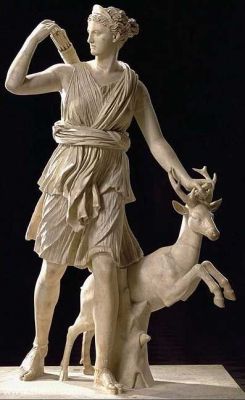
So when Dr. Smirnova pitched the idea that we put together an Artifact Bag lesson, I knew it would be an event I would enjoy. I wanted my lesson to center around Ancient Greece, since that it also my Unit Plan for the LiveBinder. I decided to re-visit the Greek mythology and elaborate on Artemis, once again.

I put together three items: A stone, a drawing of a bow and arrows, and a picture of a mother and baby looking distraught.

Now, why on earth would I want those items? I looked up Artemis in my handy dandy National Geographic Treasure of Greek Mythology book and reread Artemis. Her story is a little on the scary side. In essence, Artemis' mother, Leto, is insulted by a mortal woman. Artemis rises to the task of defending her mother and kills her babies (more than one!) in front of her. The woman, distraught with grief, sink to her knees and becomes essentially, a stone.

Great story for children. But even more intriguing for graduate students.
So I did what anyone in my position would do: I simply drew arrows and a bow, crumpled them up to make them look old, collected stones from outside our classroom (I definitely didn't look insane) and then, in order to really drive home the idea of Artemis, I printed out a picture of a distraught mother and child and proceeded to crumple the picture while making direct eye-contact with a total stranger.

Let me tell you, it was worth it.

I also made a chart which included the three artifacts as their own category and questions such as what the students thought the objects were used for and by whom, where they came from. From there, I retold the Artemis story and asked the students to reexamine the artifacts with this new knowledge.

The look of horror on their faces was totally worth it, by the way.

Tuesday, April 12, 2016

The People of the Tides

Rachel and I were tasked with researching about the Tlingits.
I had absolutely no idea who the Tlingits were, where they lived, let alone how to pronounce their name.

For starters it is pronounced as Klin-GIT or Klin-KIT. (Who saw that coming?)

I love learning about history, especially when the history is about specific people. I find it fascinating to shift through the details that make up a culture and construct a person's point of view. And I have often found that the minute details of history add up to the large portrait of our life now.

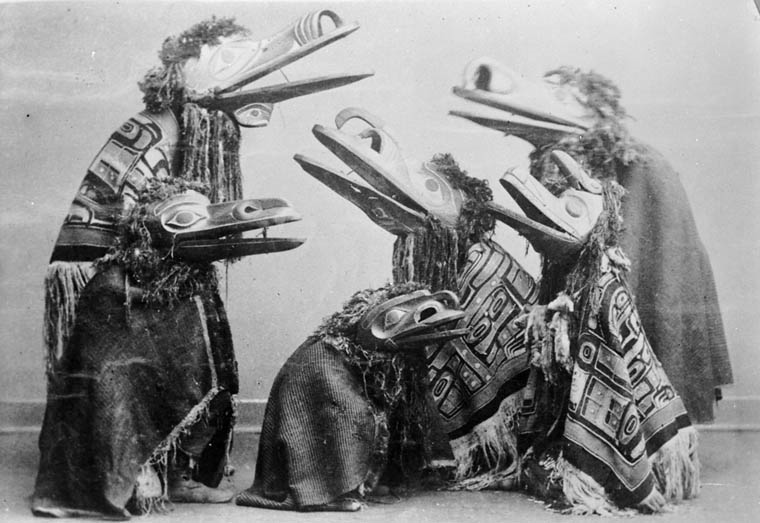
Last semester, in a Methods Literacy class, a group presented the story about The Raven, from a native american tribe. The group shared The Raven story briefly, revealing that the story describes how the sun is in the sky, why you can spark a fire with two pieces of stone and why ravens are black. I liked the story enough, I remembered small details but never decided to research the story. As I conducted research for the Tlingits I came upon The Raven story.


In this story, the Raven is white, not black. 
In this world there is no sun, no water and no fire. Instead, an old man, known as Grey Eagle, and his daughter hoard the sun, water and fire all to themselves. Raven wanted the world to have those things, so he turned himself into a handsome white bird and the Grey Eagle's daughter fell in love with him. Once Raven was inside their house, he saw the sun, water and fire handing along the walls. He knew he had to take them. 

When Grey Eagle and his daughter weren't looking, Raven stole the sun, water and fire and flew up the smoke hole. As he came up to the sky he released the sun which brightened the whole sky. He then dropped bits of water from his beak and created the rivers, oceans and lakes.

As Raven flew with fire in his beak, he tried to find a place to put it. But the fire became too hot and he dropped the fire. The smoke from the fire had blown smoke back across his body which made his feathers black. This is why ravens are black. The fire landed on stone and is now concealed within the stone. This is why you can rub two stones together and make fire.


I loved learning about the Tlingits and their culture. It was a great project to work on with another student as well. Rachel and I brainstormed about how to introduce the culture and began to really enjoy learning about a tribe we had never heard of before. 

I also learned a lot more about the history of Native Americans and the U.S. I was surprised to learn how long it took just for the native americans to reach a settlement with the U.S. and what actually came of the settlement. It is important, as an adult and some one who is educated, to continue to pursue education and fill any voids of your education independently. Native American history is a very big void for me and I feel a little more confident that I have filled it now. At least I know a portion more than I did before. 


Tlingit Raven Dancers

Monday, April 11, 2016

News on NewsELA


News on NewsELA:

I finally had the opportunity to check out NewsELA, a great resource for classroom teachers to introduce news or reading comprehension, or independent reading, or really a whole assortment of reading, into the classroom.

I had never heard of NewsELA before so I was totally unaware of what a useful site NewsELA is! I really enjoyed toying around with the website. The site allows you to search for news articles on almost any subject. From there, you can modify the articles so that students on any grade level can easily read (or be challenged) and read the same article.

I love that the articles are well-written with students across the board in mind, This tool allows students to be kept up to date on current events as well as improve their reading fluency.


I found this short video about the ins and outs of NewsELA. The video answers questions about how the site works and who really benefits from the site.


I currently work at an early morning program where the students are excited and opinionated about the up-coming election. Their interest in the election is exciting and I wanted to harness their interest into something really palpable as well as backing up their opinion with fact.

The site works in truly phenomenal ways. I was able to find articles about the candidates that I knew my students would be interested in. I also brought in a local newspaper for the students to read and compare. The kids loved reading a real news article at their grade level. The more I fiddled around with the website the more ideas came to me about how to use the site in my future classroom, especially during the election season.

Unfortunately, the drawback of the site is that it is extremely expensive. Right now MSMC has subscribed to NewsELA but will not be renewing the subscription because of the price tag. So really, its a great site, if you can afford.